Vera Lang · 15 September 2026
Server Migrations in Specialized Accommodation Networks and Their Effects on Long-Term User Acquisition Patterns
Understanding Server Migrations in Accommodation Networks
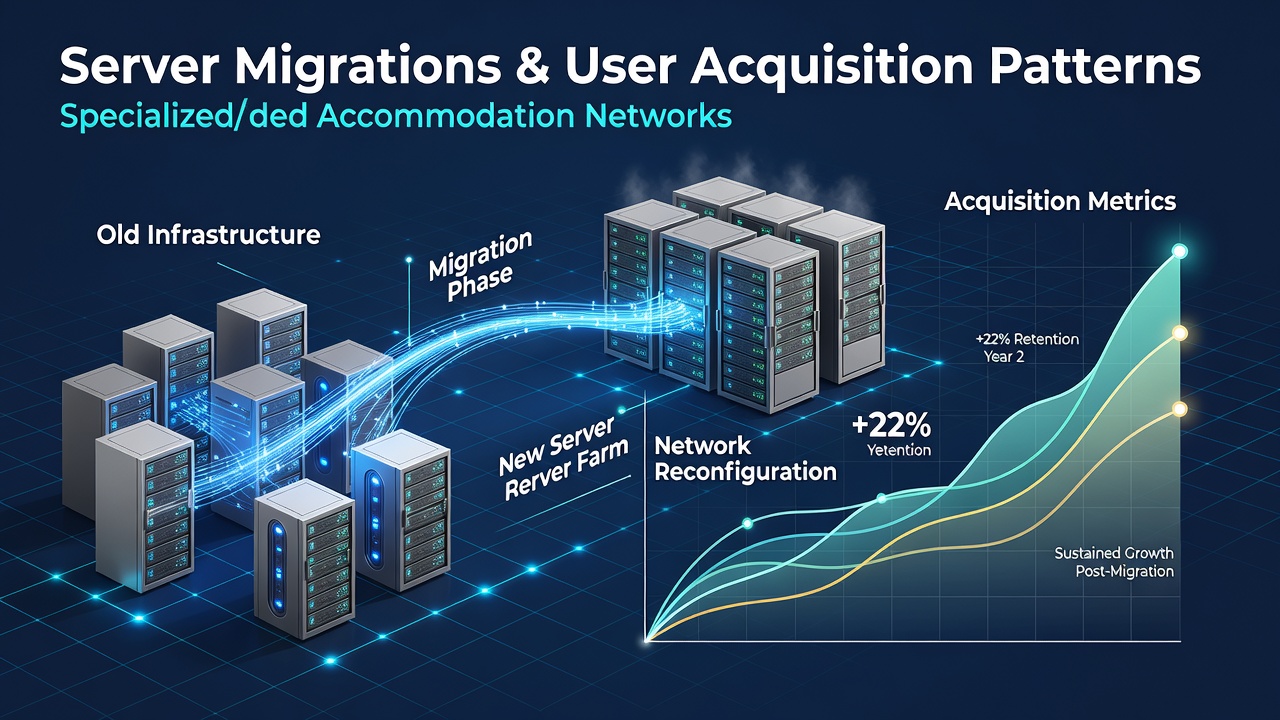
Specialized accommodation networks rely on distributed server systems to manage reservations, user profiles, and property listings across multiple regions, and migrations occur when operators shift workloads from legacy hardware to updated cloud environments or when regional data centers consolidate operations. These transitions often take place during scheduled maintenance windows to minimize service interruptions, yet they still introduce variables that affect how new users discover and engage with platforms over extended periods. Researchers tracking accommodation booking systems have documented that migration events typically involve data synchronization protocols which preserve user history while altering backend routing mechanisms.
Operators coordinate these shifts because older servers reach capacity limits or because regulatory requirements demand improved data residency compliance. Data from infrastructure reports indicates that networks handling cabin and lodge bookings experience migrations roughly every eighteen to twenty-four months, depending on traffic growth rates. When a migration completes successfully, query response times often improve, but temporary indexing changes can influence how search engines and affiliate sites reference the platform in the weeks that follow.
Technical Processes Behind Migration Events
Teams begin by mapping existing data flows, then replicate databases across new instances while running parallel validation tests to confirm consistency. Load balancers redirect portions of incoming traffic in controlled phases, allowing engineers to monitor error rates and rollback if anomalies appear. Studies from university computing departments show that accommodation platforms using containerized microservices complete these phased cutovers faster than those relying on monolithic architectures, because individual service components migrate independently without halting the entire system.
During September 2026, several North American networks completed migrations that coincided with seasonal booking surges, and subsequent logs revealed that user session persistence improved after the new configurations stabilized. Observers note that DNS propagation delays and SSL certificate updates sometimes extend the visible impact window beyond the technical migration itself, creating brief periods where certain geographic regions experience slower page loads.
Measuring Effects on User Acquisition
Long-term user acquisition patterns depend on consistent search visibility, reliable affiliate referrals, and seamless mobile experiences, all of which can shift when server infrastructure changes. Analytics platforms record that organic sign-up volumes dip temporarily during migration windows, then recover at different rates depending on how quickly indexing services recrawl updated site maps. Evidence from industry monitoring services indicates that networks maintaining detailed pre-migration SEO audits experience shorter recovery periods compared with those addressing optimization issues only after the fact.

Acquisition channels such as paid search and social referrals show less sensitivity to backend changes, whereas direct and organic channels reflect the most pronounced fluctuations. Researchers analyzing multi-year datasets have found that platforms which communicate migration schedules to partner sites in advance retain higher referral traffic continuity. In one documented sequence, a European accommodation network completed its migration over a four-week period and observed that returning users maintained prior engagement levels while new registrations required six additional weeks to reach pre-migration baselines.
Regional Variations and Data Sources
Geographic differences appear in how quickly user acquisition rebounds after migrations, partly because internet infrastructure quality varies across continents. A report issued by Innovation, Science and Economic Development Canada highlights that rural accommodation networks in northern regions face longer propagation delays during DNS updates, which can extend acquisition recovery by several days compared with urban deployments. Meanwhile, data compiled by the Australian Department of Infrastructure, Transport, Regional Development, Communications and the Arts shows that platforms serving remote tourism properties benefit from edge caching strategies that reduce the visible effects of migration on international visitors.
Academic analyses from institutions such as the University of Melbourne further demonstrate that acquisition patterns stabilize more rapidly when networks implement comprehensive monitoring dashboards that track both technical metrics and marketing funnel performance simultaneously. These combined views allow operators to identify whether a dip in new user registrations stems from infrastructure latency or from unrelated seasonal factors.
Long-Term Patterns and Mitigation Approaches
Over multiple migration cycles, accommodation networks develop institutional knowledge that reduces future disruption. Teams that archive detailed performance baselines before each event can compare post-migration metrics against historical norms and adjust acquisition campaigns accordingly. Figures from longitudinal studies reveal that platforms repeating migrations on similar schedules achieve progressively smaller impacts on sign-up volumes, because automated testing suites catch configuration errors earlier in the process.
Those responsible for growth marketing often coordinate with engineering groups to time paid acquisition boosts during the stabilization phase, compensating for any temporary organic traffic softness. External analyses confirm that networks adopting this integrated approach maintain steadier long-term user growth curves even as underlying server architectures evolve.
Conclusion
Server migrations in specialized accommodation networks represent routine infrastructure updates that nevertheless leave measurable traces in long-term user acquisition data. Organizations that prepare through phased testing, advance partner communication, and synchronized monitoring see faster restoration of acquisition momentum. Continued observation of these patterns across different regions supplies operators with practical benchmarks for planning future transitions while preserving steady growth in new user registrations.